Introduction
Smartwatches have developed from simple digital timepieces into compact devices that can combine communication, fitness tracking, notifications, activity monitoring, and everyday utility features. For people who spend time outdoors or simply want a watch designed around a more rugged aesthetic, a larger smartwatch with multiple practical functions can be an interesting alternative to a conventional fitness band or minimalist smartwatch.
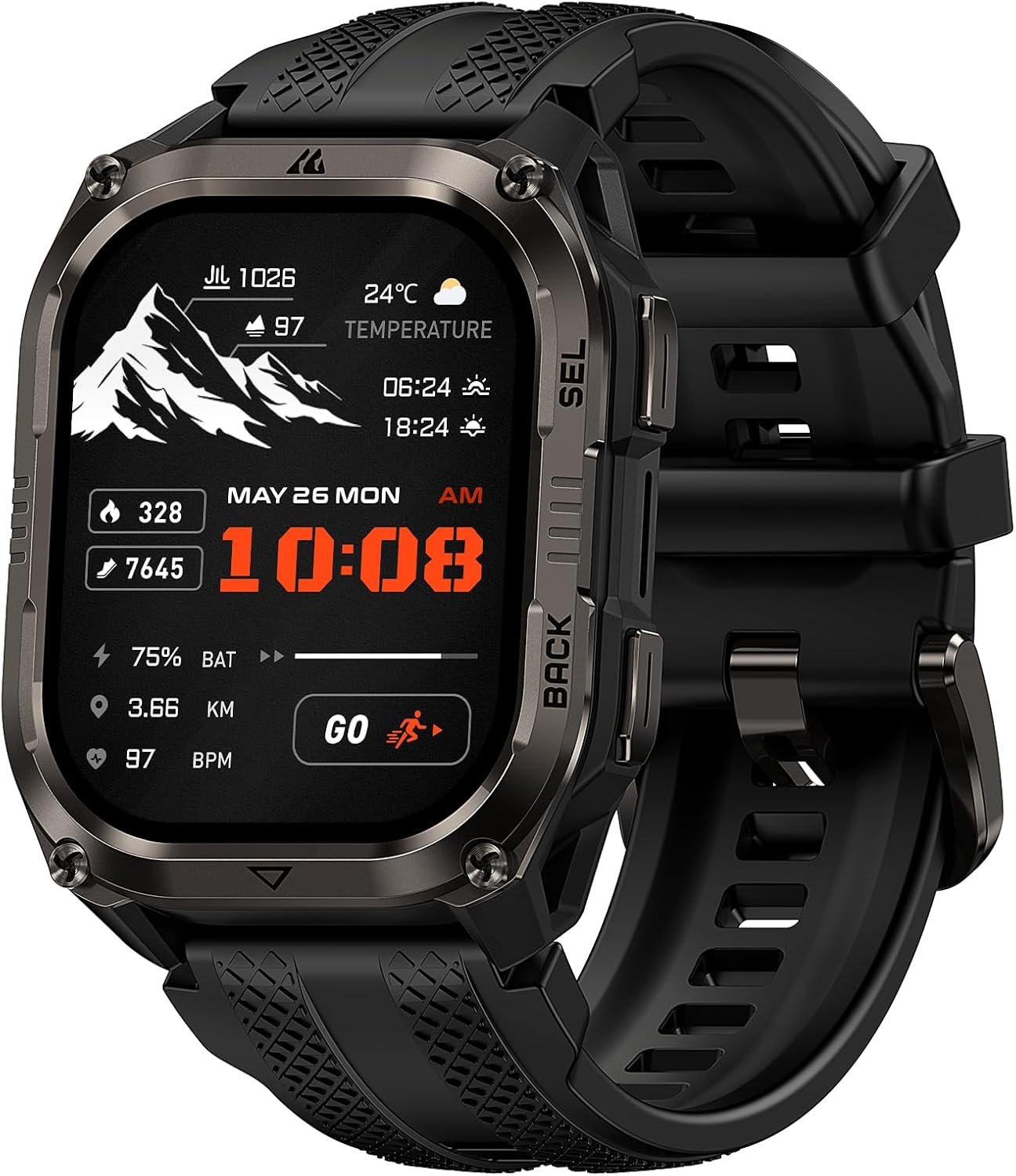
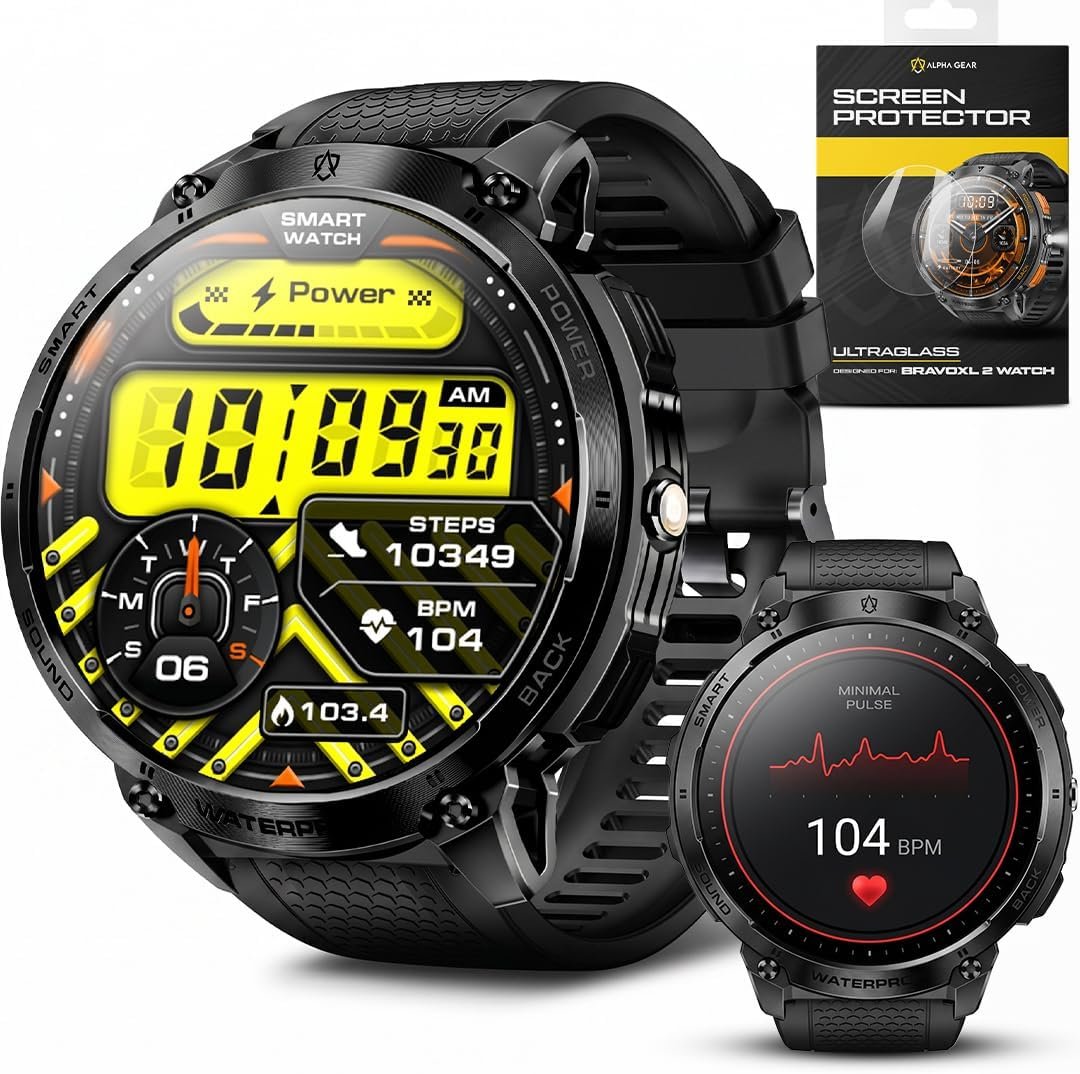
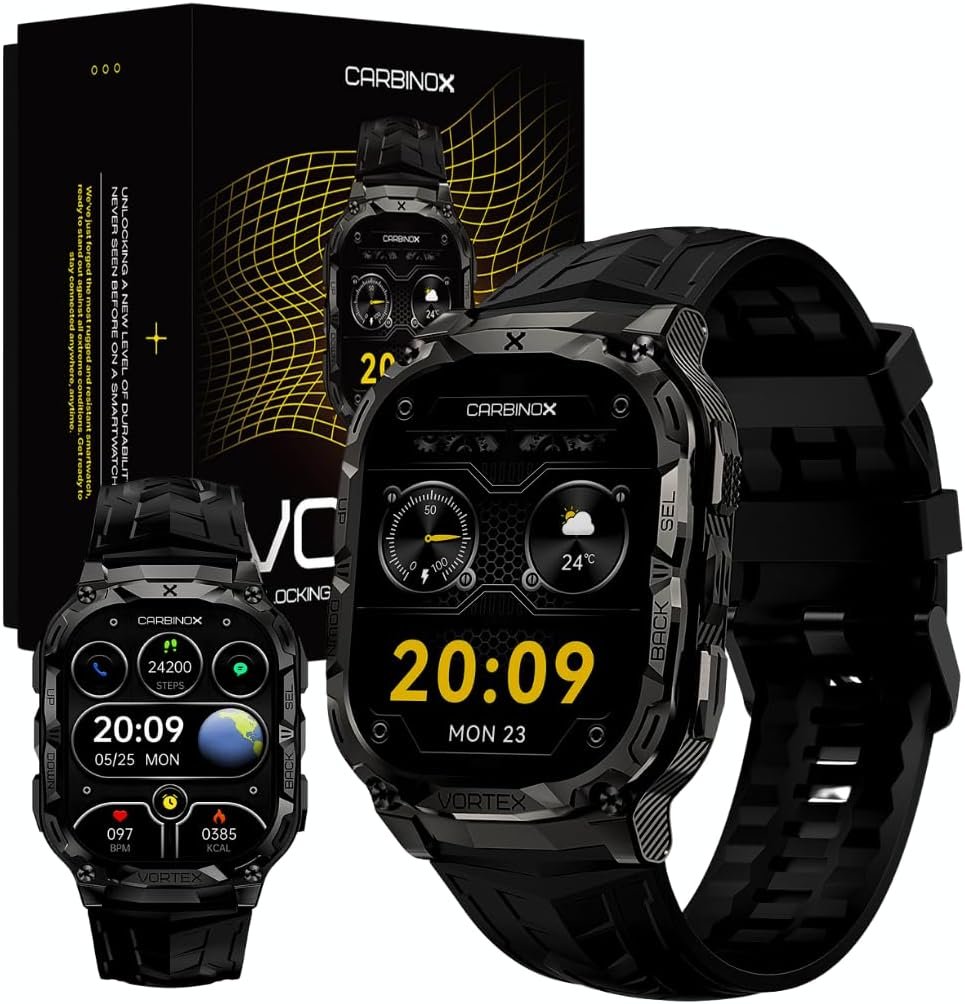
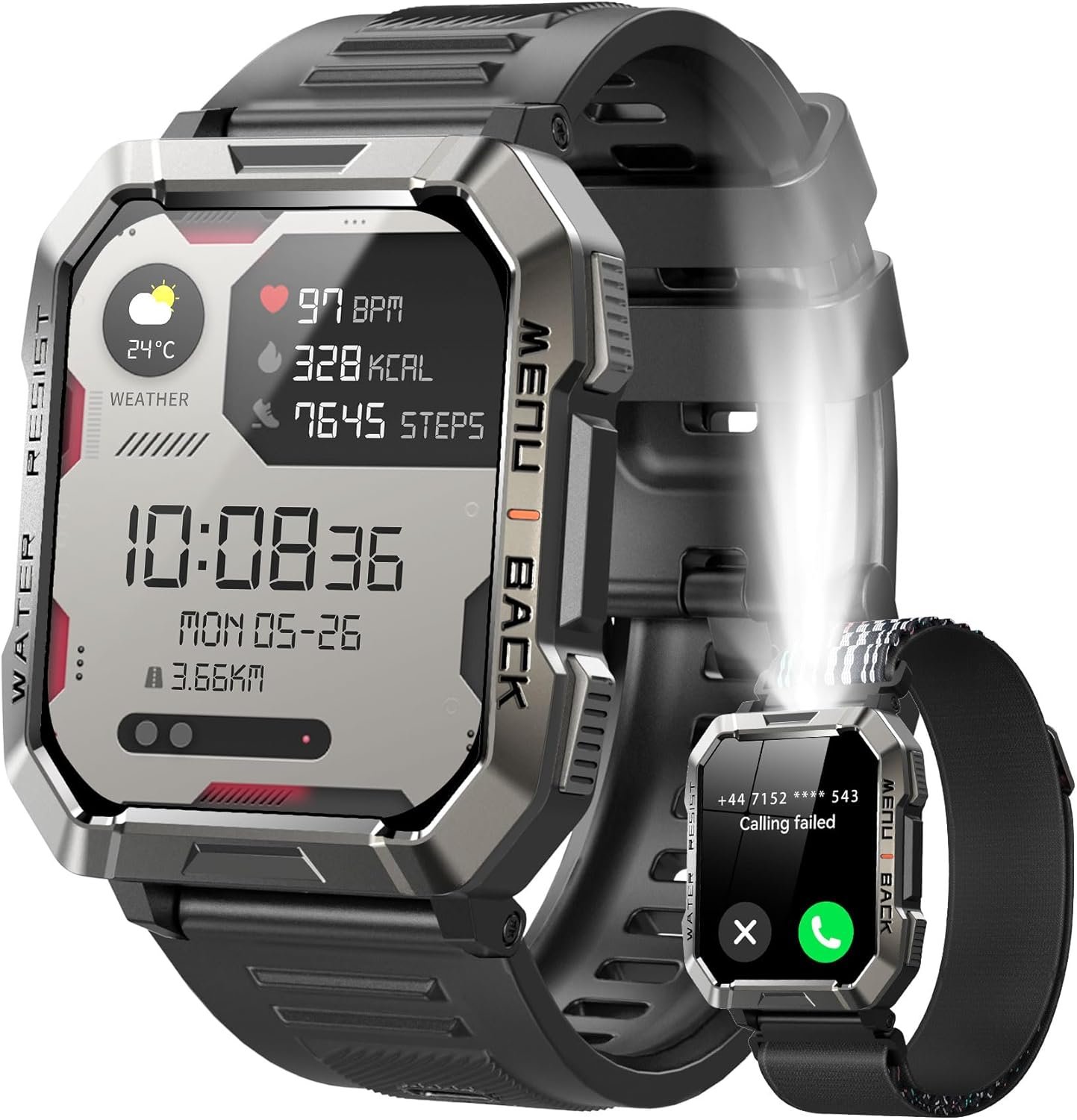
The Military Smart Watch for Men described in the product listing is built around this multifunctional concept. It features a 2.01-inch display, Bluetooth calling capabilities for answering and making calls, compatibility with Android phones and iPhones, fitness-tracking functions, a built-in flashlight, a compass, heart-rate and sleep monitoring, more than 100 sport modes, and two included straps. The listing also promotes a battery life claim of up to 100 days, which should be understood in the context of the manufacturer’s stated conditions and usage modes rather than as a guaranteed everyday runtime.
A smartwatch with this combination of features can serve several roles at once. It can provide quick access to notifications and calls, track exercise sessions, display health-related measurements, offer simple outdoor tools, and reduce the need to reach for a smartphone for certain routine tasks.
At the same time, multifunctional wearable devices require some practical considerations. Smartphone compatibility, Bluetooth permissions, app setup, battery behavior, display size, sensor limitations, privacy settings, and the difference between wellness tracking and medical measurement can all affect how the device should be used.
This guide examines the smartwatch from an informational perspective. It explains the major features, possible everyday applications, outdoor uses, fitness functions, compatibility considerations, battery expectations, and differences between this type of smartwatch and other wearable categories.
The goal is not to provide a personal review or assign a rating. Instead, the focus is on understanding how a feature-rich smartwatch can fit into different routines and what users should consider before choosing this type of wearable.
Understanding the Smartwatch Concept
A modern smartwatch typically combines several technologies inside a wrist-worn device.
At its simplest, the watch provides timekeeping. Beyond that, it may connect to a smartphone through Bluetooth and display notifications, manage calls, track physical activity, record selected health-related metrics, and provide shortcuts to commonly used functions.
The product discussed here is positioned toward users who want a relatively large display and a broad selection of features.
The 2.01-inch display is particularly relevant because screen size affects how information is presented. A larger screen can provide more room for notifications, exercise information, menus, and touch controls than a small fitness band.
The device also combines everyday communication features with outdoor-oriented tools such as a flashlight and compass.
This creates a watch that can potentially be used both during normal daily routines and during activities such as hiking, walking, camping, cycling, or other outdoor pursuits.
Key Features
2.01-Inch Display
The 2.01-inch screen is one of the most visible characteristics of the smartwatch.
A larger display can make certain information easier to view, including notifications, call controls, workout information, menus, and other on-screen data.
Screen size also affects the physical footprint of the watch. A larger display may be helpful for readability, but it can also feel more substantial on a smaller wrist.
Touchscreen usability can also vary depending on the user’s fingers, environmental conditions, screen brightness, and whether the device is being used while moving.
For users who frequently interact with their watch rather than simply checking the time, display size can be an important consideration.
Bluetooth Calling
The product is designed to support answering and making calls through a connected smartphone.
This type of functionality generally relies on Bluetooth communication between the watch and phone.
Once appropriately paired, the watch can provide a way to interact with incoming calls without immediately taking the smartphone out of a pocket or bag.
The exact calling experience depends on the phone, Bluetooth connection, permissions, and software configuration.
A smartwatch should not automatically be treated as an independent cellular phone unless the product specifically includes cellular connectivity and a supported service. Bluetooth calling generally depends on the paired smartphone being within an appropriate connection range.
Android and iPhone Compatibility
The product is described as compatible with both Android smartphones and iPhones.
Cross-platform compatibility can make a smartwatch more flexible for households where people use different smartphone ecosystems.
However, compatibility does not necessarily mean that every feature works identically on every phone.
Android and iOS manage permissions, notifications, Bluetooth communication, background applications, and health data differently.
Before setup, users should check the current compatibility requirements and the companion application’s supported operating-system versions.
Fitness Tracking
Fitness tracking is a central part of the device’s feature set.
A smartwatch can monitor activity during walking, running, cycling, workouts, and other forms of exercise.
Depending on the selected sport mode, the watch may display information such as elapsed time, movement, estimated calories, distance, or other activity-related measurements.
These measurements are generally intended for wellness and fitness purposes.
Users should understand that wearable sensors provide estimates rather than laboratory-grade measurements. Factors such as wrist position, movement, skin contact, activity type, and device placement can influence readings.
More Than 100 Sport Modes
The product listing promotes more than 100 sport modes.
A large sport-mode selection can make the watch useful for people who participate in different types of physical activities.
Sport modes can allow users to organize workouts according to the type of activity being performed rather than treating every session as a generic exercise.
The usefulness of a large mode library depends on how accurately the selected mode corresponds to the activity.
Not every sport mode necessarily provides the same level of measurement or tracking.
Users should also remember that selecting a named activity does not turn the smartwatch into a specialized professional sports instrument.
Heart-Rate Monitoring
The smartwatch includes heart-rate monitoring.
Wrist-based optical sensors can estimate heart rate by detecting changes in blood flow near the skin.
This can be useful for observing general trends during rest or exercise.
However, consumer smartwatch heart-rate measurements should not automatically be treated as medical readings.
Accuracy can be influenced by movement, wrist position, skin contact, exercise intensity, and other factors.
People who require medical-grade monitoring should use equipment recommended by an appropriate healthcare professional rather than relying on a consumer smartwatch.
Sleep Tracking
Sleep tracking is another feature associated with the device.
Wearables can use movement and sensor data to estimate aspects of sleep, such as periods of rest and wakefulness.
Sleep tracking can be useful for observing general patterns over time.
However, consumer devices do not necessarily measure sleep with the same methods used in clinical sleep studies.
A smartwatch’s sleep information is therefore better understood as a wellness-oriented estimate rather than a diagnostic assessment.
Built-In Flashlight
A flashlight can be useful in everyday situations.
It can provide a small source of illumination when searching for something in a dark room, walking through a poorly lit area, checking equipment, or navigating around a campsite.
Because the light is integrated into the watch, it is available without carrying a separate flashlight.
The size of a smartwatch limits the physical size and power of its lighting component, so a built-in watch flashlight should generally be viewed as a convenience light rather than a replacement for a dedicated high-output flashlight.
Compass
The inclusion of a compass adds an outdoor-oriented function.
A digital compass can help users understand general direction while walking, hiking, camping, or exploring unfamiliar areas.
However, compass sensors may need calibration and can be affected by nearby magnetic materials or electronic equipment.
A digital compass should also not automatically replace a proper navigation system, physical map, or dedicated navigation equipment in situations where reliable orientation is critical.
Two Straps
The package includes two straps.
Having an additional strap can provide flexibility for different situations or preferences.
For example, one strap might be used during everyday activities while the other is reserved for exercise or outdoor use.
The exact materials, colors, and attachment mechanism should be confirmed from the current product listing.
Strap comfort can matter significantly because fitness sensors rely on reasonable skin contact.
How It Can Be Used
Everyday Timekeeping
The smartwatch can serve as a conventional wristwatch while adding digital functions.
Users can check the time without reaching for their phone and then access other information when needed.
This can be especially convenient during work, commuting, exercise, or outdoor activities.
Managing Phone Notifications
When paired with a smartphone, a smartwatch can provide quick access to notifications.
This can reduce the need to repeatedly check a phone during routine activities.
Depending on the companion application and operating system, notifications may include calls, messages, app alerts, reminders, and other supported notifications.
The exact behavior depends on permissions and phone settings.
Answering Calls
Bluetooth calling can be useful when a smartphone is nearby but inconvenient to hold.
For example, someone working at a desk might answer a call from the watch rather than reaching for the phone.
The watch can also be useful during household activities when the phone is nearby but not immediately accessible.
Call quality depends on the watch’s microphone and speaker, the Bluetooth connection, background noise, and the connected phone.
Exercise Tracking
The smartwatch can accompany workouts such as walking, running, cycling, gym sessions, and other supported activities.
Selecting an appropriate sport mode can provide activity-specific tracking.
The watch can also help users maintain a record of exercise sessions over time, depending on the companion application and data synchronization.
Outdoor Walking and Hiking
The compass and fitness functions make the watch relevant to outdoor walking and hiking.
A user might use the compass for general directional awareness while using a sport mode to record activity.
The built-in flashlight can also provide convenient illumination during low-light conditions.
However, outdoor navigation should not depend entirely on a smartwatch. A phone, map, dedicated navigation device, or other backup method can be important in unfamiliar or remote environments.
Camping
At a campsite, a smartwatch can provide several small conveniences.
The flashlight can help illuminate nearby objects. The watch can track walking or other activity, display the time, and potentially provide notifications when a phone connection is available.
The compass can also provide general directional information.
A smartwatch is not a replacement for dedicated camping equipment, but multiple small features can make it useful as part of a broader setup.
Cycling
Cyclists can use a smartwatch to track activity and access selected information without constantly holding a smartphone.
The usefulness of the watch depends on the cycling mode, sensor behavior, and whether the rider needs more specialized cycling metrics.
For serious training, dedicated cycling computers may offer additional capabilities.
Gym Workouts
At the gym, the smartwatch can track supported exercises and monitor heart-rate trends.
It can also display the time and notifications.
Wearing the watch securely but comfortably can help maintain better sensor contact during movement.
Work and Office Use
A large smartwatch can also function as a productivity accessory.
Notifications can provide quick information without interrupting work.
Call functionality can be useful when a smartphone is nearby.
Users can also use the watch as a simple timekeeping device during meetings, work sessions, or other activities.
Who It May Be Suitable For
Active Adults
People who participate in multiple forms of exercise may appreciate a broad sport-mode library.
The watch can provide a single wearable for different activities instead of requiring separate devices for every workout.
Outdoor Enthusiasts
People who enjoy hiking, walking, camping, or outdoor recreation may find the combination of compass, flashlight, activity tracking, and smartphone connectivity useful.
The exact usefulness depends on the environment and the user’s expectations.
People Who Want Wrist-Based Calling
Users who frequently receive calls while their smartphone is nearby may appreciate Bluetooth calling.
The feature can provide a convenient way to interact with calls without immediately handling the phone.
Android and iPhone Users
Cross-platform compatibility can make the device relevant to people using either major smartphone ecosystem.
The companion application’s compatibility requirements should still be checked before setup.
People Who Prefer Larger Displays
The 2.01-inch display may appeal to users who prefer a more substantial screen for reading information and interacting with menus.
Users Looking for Multiple Functions in One Device
The watch combines communication, fitness tracking, wellness measurements, lighting, navigation assistance, and timekeeping.
For users who prefer multifunctional devices, this can reduce the need to carry several separate accessories.
Important Things to Consider
Smartphone Dependency
Bluetooth calling and many notification features generally depend on a connected smartphone.
The watch should not be assumed to function as an independent phone unless the product specifically supports cellular connectivity.
If the phone is unavailable, powered off, or outside Bluetooth range, certain communication functions may not work.
Battery-Life Claims
The product listing promotes a battery life of up to 100 days.
A long battery-life claim should be interpreted carefully.
Smartwatch battery life can vary dramatically depending on usage. Frequent Bluetooth calls, screen activity, notifications, sensor monitoring, brightness, sport tracking, and other functions can consume more power.
A quoted maximum may represent a particular low-use or standby condition rather than normal daily use.
Consumers should therefore look at battery claims as manufacturer estimates under specified conditions rather than a guaranteed runtime.
Heart-Rate Accuracy
Heart-rate sensors on consumer smartwatches are useful for general fitness awareness but are not necessarily equivalent to medical equipment.
Movement and poor sensor contact can affect readings.
The watch should not be used to diagnose or manage a medical condition unless a qualified healthcare professional specifically recommends it for that purpose.
Sleep Tracking Limitations
Sleep information is generally an estimate.
A smartwatch cannot necessarily distinguish every sleep stage or sleep-related condition with clinical accuracy.
If someone experiences persistent sleep problems or symptoms of a sleep disorder, professional medical evaluation is more appropriate than relying solely on smartwatch data.
Compass Calibration
Digital compasses can require calibration.
Nearby metal objects, magnets, electronics, and certain environments can influence compass readings.
Users should follow the manufacturer’s calibration instructions and avoid assuming that a digital compass provides perfect directional accuracy in every situation.
Display Size and Comfort
A 2.01-inch display provides more viewing area but also contributes to the physical size of the watch.
People with smaller wrists may want to consider dimensions and strap adjustment before choosing a larger smartwatch.
Comfort becomes particularly important during sleep and exercise.
Water and Environmental Resistance
Consumers should not assume that a rugged-looking or military-style smartwatch is automatically waterproof or suitable for every outdoor condition.
Actual water resistance depends on the manufacturer’s specifications and rating.
Before swimming, showering, or exposing the watch to significant water, users should confirm the current product’s specific resistance rating and limitations.
Privacy and Permissions
A smartwatch connected to a smartphone may request permissions for notifications, Bluetooth communication, contacts, calls, activity data, and other functions.
Users should review permissions carefully.
Only the permissions necessary for desired functions need to be enabled where the operating system allows that choice.
The companion application’s privacy policy should also be reviewed to understand how collected information is handled.
Understanding Smartwatch Health Measurements
Wearable devices increasingly provide health-related information.
It is useful to distinguish between wellness tracking and medical measurement.
A smartwatch can provide estimates of heart rate, activity, sleep patterns, and other metrics.
These estimates can help users observe trends.
For example, someone may notice that their activity level changes during different weeks or that their sleep schedule varies.
However, a trend displayed by a consumer device is not necessarily a clinical diagnosis.
Measurements can be affected by sensor placement, movement, skin characteristics, device fit, and algorithms.
The best approach is to treat smartwatch health information as supplementary wellness data unless a healthcare professional advises otherwise.
Comparing Smartwatch Categories
Multifunction Smartwatch vs. Fitness Band
Fitness bands are typically smaller and focus on activity and wellness tracking.
A multifunction smartwatch generally provides a larger screen and broader interaction capabilities.
The larger device may offer calling, notifications, apps, and other features that are less prominent on basic fitness bands.
A fitness band may appeal to users who prioritize a lightweight design and simple activity tracking.
Smartwatch vs. Traditional Watch
A traditional watch primarily provides timekeeping.
A smartwatch can provide timekeeping plus notifications, calls, exercise tracking, and other digital features.
The trade-off is that smartwatches usually require charging, software setup, and some connection to a smartphone.
Traditional watches generally have fewer electronic dependencies.
Smartwatch vs. Dedicated Fitness Tracker
A dedicated fitness tracker is generally focused on activity and wellness measurements.
A multifunction smartwatch attempts to combine those functions with communication and everyday digital tools.
For someone primarily interested in exercise data, a dedicated tracker may provide a simpler experience. For someone who wants both fitness functions and smartwatch capabilities, a multifunction model may be more relevant.
Smartwatch vs. Outdoor GPS Watch
Dedicated outdoor GPS watches are designed around navigation, endurance sports, and specialized outdoor metrics.
The product discussed here includes a compass and fitness functions, but that does not automatically make it equivalent to a specialized GPS sports watch.
Users who participate in serious navigation or endurance activities should compare the specific navigation, mapping, GPS, sensor, and battery capabilities they require.
Smartwatch vs. Dedicated Flashlight
A watch-integrated flashlight is convenient because it is always attached to the wrist.
A dedicated flashlight can typically provide a larger light source, longer runtime, greater brightness, and more specialized beam control.
The smartwatch flashlight is therefore best viewed as a convenience feature rather than a complete replacement for dedicated lighting equipment.
Battery Management in Everyday Use
Battery life is one of the most important practical considerations for any smartwatch.
Several habits can influence battery consumption.
Frequent calls can consume more power than simply checking the time.
Continuous sensor monitoring can also increase energy usage.
A bright display and frequent screen activation can further reduce runtime.
Sport tracking can be particularly demanding because the device may continuously collect sensor information.
Users who want longer intervals between charging can adjust settings such as screen brightness, notification frequency, sensor monitoring, and other available functions.
The exact battery-saving options depend on the device software.
Setting Up the Smartwatch
A typical smartwatch setup process involves several stages.
First, the device needs to be charged sufficiently.
Next, the appropriate companion application should be installed on the compatible smartphone.
Bluetooth is then enabled, and the watch is paired with the phone.
Depending on the application, users may be asked to authorize notifications, calls, contacts, activity tracking, or other permissions.
After pairing, users can configure watch faces, notifications, sport modes, health-related features, and other settings.
Taking time to review these settings can help prevent unwanted notifications or permissions.
Making Notifications Less Distracting
A smartwatch can make communication more convenient, but constant notifications can also become distracting.
Users can often select which apps are allowed to send alerts to the watch.
For example, someone might choose to receive calls and important messages while disabling notifications from less important applications.
This can make the smartwatch more useful as an information filter rather than simply creating another source of alerts.
The available controls depend on the phone’s operating system and companion application.
Using the Watch During Exercise
For fitness tracking to be useful, the watch needs to be worn appropriately.
The strap should be secure enough to maintain consistent contact without becoming uncomfortably tight.
Loose positioning can make optical sensor readings less reliable.
During exercise, excessive movement of the watch on the wrist can also affect measurements.
Users should follow the manufacturer’s guidance for wearing the device during workouts.
Frequently Asked Questions
Does the smartwatch work with Android phones?
The product is described as compatible with Android smartphones. Users should check the current compatibility requirements and supported Android versions before setup.
Does it work with iPhone?
The product listing describes compatibility with iPhone devices. The companion application’s current iOS requirements should be checked before purchase and setup.
Can it make phone calls?
The product is designed to support Bluetooth calling, allowing users to answer and make calls through a connected compatible smartphone.
Does it work without a phone?
Some basic watch functions may work independently, but Bluetooth calling, notifications, and many connected features generally depend on the paired smartphone. It should not be assumed to provide independent cellular calling unless cellular connectivity is specifically included.
What is the screen size?
The product is described as having a 2.01-inch display.
How many sports modes does it have?
The product listing advertises more than 100 sport modes. The exact tracking capabilities can vary by activity mode.
Does it monitor heart rate?
Yes. The smartwatch includes heart-rate monitoring. These readings should be considered wellness estimates rather than medical measurements.
Can it track sleep?
Yes. Sleep tracking is included as one of the advertised wellness features. Sleep information should be interpreted as an estimate rather than a clinical sleep study.
Does it have a flashlight?
Yes. The product includes a built-in flashlight function intended for convenient illumination.
Does it have a compass?
Yes. A compass is included. Users should follow calibration instructions and understand that magnetic interference can affect digital compass readings.
How long does the battery last?
The product listing promotes up to 100 days of battery life. Actual runtime depends heavily on usage, settings, connectivity, screen activity, calls, and sensor use. A maximum battery-life claim should not be interpreted as guaranteed everyday performance.
Is the smartwatch suitable for swimming?
That depends on the exact water-resistance specification of the current product. Consumers should verify the manufacturer’s stated water-resistance rating and limitations before exposing the watch to water.
Can it replace a medical heart-rate monitor?
It should not automatically be treated as a replacement for medical equipment. Consumer smartwatch sensors provide estimates and may be affected by movement and other factors.
Is the compass suitable for serious navigation?
A built-in digital compass can provide general directional information, but users should not rely on it as their only navigation method in situations where accurate navigation is critical.
Is the 2.01-inch screen suitable for everyone?
A larger screen can improve visibility and touch interaction, but the larger watch body may not be equally comfortable for every wrist size.
Does it include two straps?
The product listing identifies two straps as part of the package. The exact strap materials and designs should be confirmed from the current listing.
Can it track different types of exercise?
The product advertises more than 100 sport modes, allowing users to select from a broad range of activity categories.
Can the watch receive phone notifications?
When properly paired and configured with a compatible smartphone, supported notifications can be displayed on the watch. Availability depends on phone permissions and the companion application.
Can the watch be used outdoors?
The combination of fitness tracking, compass, flashlight, and smartphone connectivity can make it useful for outdoor activities. However, users should verify the environmental and water-resistance specifications before using it in demanding conditions.
Conclusion
The Military Smart Watch for Men with a 2.01-inch display is designed as a multifunctional wearable that combines communication, fitness tracking, wellness monitoring, and practical outdoor-oriented tools.
Its feature set includes Bluetooth calling, Android and iPhone compatibility, more than 100 sport modes, heart-rate and sleep tracking, a built-in flashlight, a compass, and two straps. The larger 2.01-inch display provides space for notifications, workout information, menus, and other interactions.
These functions can make the smartwatch relevant to a variety of situations. It can be used for everyday timekeeping, phone notifications, calls, workouts, walking, cycling, hiking, camping, office use, and travel.
Several considerations are important, however. Bluetooth calling and many connected features depend on a compatible smartphone. Battery life can vary considerably depending on usage, so the advertised maximum of up to 100 days should be understood as a manufacturer claim under particular conditions rather than a guaranteed everyday runtime.
The health-related features should also be interpreted appropriately. Heart-rate and sleep measurements can provide useful wellness information and help users observe trends, but they are not automatically equivalent to medical-grade measurements. Similarly, the compass can assist with general orientation but should not necessarily be the sole navigation method in demanding environments.
The smartwatch’s rugged or military-inspired design can make it appealing to users who want a substantial wearable with multiple functions, while the two included straps provide additional flexibility for everyday use.
For consumers considering a smartwatch that combines communication, fitness features, wellness tracking, and basic outdoor tools in one wrist-worn device, understanding the capabilities and limitations of each feature is an important part of making an informed choice.